
This article discuses the ligaments in the subaxial cervical spine.
The subaxial cervical spine (C3–C7) is stabilized by a complex system of intervertebral discs and ligaments that balance flexibility with stability. These ligaments prevent excessive motion, protect the spinal cord, and maintain alignment during physiological movements such as flexion, extension, and rotation.
Anterior Longitudinal Ligament (ALL)
- Runs along the anterior surfaces of vertebral bodies and discs.
- Extends from the clivus and anterior tubercle of C1 down to the sacrum.
- Function: Prevents hyperextension and provides anterior stability.
Posterior Longitudinal Ligament (PLL)
- Lies on the posterior surfaces of vertebral bodies inside the vertebral canal.
- Extends from the body of C2 to the sacrum.
- Narrower in the cervical spine, which explains the propensity for posterolateral disc herniations.
- Function: Prevents hyperflexion and posterior disc protrusion.
Intervertebral Disc
- Made of nucleus pulposus (gel-like) and annulus fibrosus (fibrous lamellae).
- Provides cushioning and distributes loads between vertebrae.
- In the cervical spine, discs also contribute to mobility and height.
Ligamentum Flavum
- Elastic ligament connecting laminae of adjacent vertebrae.
- Rich in elastin fibers → yellowish appearance (“flavum”).
- Function: Assists return to extension after flexion, and protects dura from buckling.
Interspinous Ligament
- Connects adjacent spinous processes.
- More membranous in the cervical spine compared to lumbar.
- Resists excessive flexion.
Nuchal Ligament
- Cervical expansion of the supraspinous ligament.
- Extends from the external occipital protuberance to C7 spinous process.
- Provides midline attachment for muscles (trapezius, splenius capitis).
- Helps maintain cervical lordosis and limits flexion.
Facet Capsule (Zygapophyseal Joint Capsule)
- Thin but strong capsule surrounding the facet joints.
- Reinforced by multifidus and ligamentum flavum fibers.
- Function: Guides motion and prevents hyper-translation.
Image
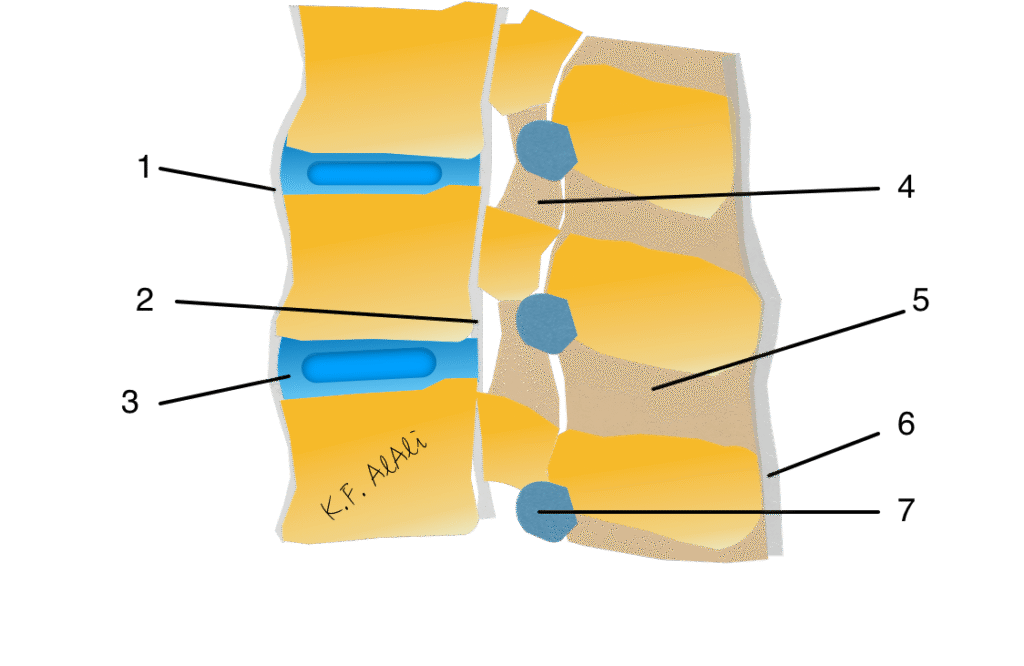
Figure: Lateral cervical spine. 1. Anterior longitudinal ligament. 2. Posterior longitudinal ligament. 3. Intervertebral disc.4. Flavum ligament. 5. Interspinal ligament. 6. Nuchal ligament. 6. Facet capsule.


