
The atlas (C1) is the first cervical vertebra and plays a pivotal role in craniovertebral junction biomechanics. Unlike other vertebrae, it lacks a vertebral body and a spinous process, forming instead a ring-like structure that articulates with the occiput superiorly and the axis (C2) inferiorly.
Anterior Tubercle
- Small midline prominence on the anterior arch.
- Attachment point for:
- Anterior longitudinal ligament
- Longus colli muscle
Anterior Arch
- Forms the anterior one-fifth of the C1 ring.
- Features a facet for the dens (odontoid process) on its posterior surface.
- Articulates with the dens of C2 for axial rotation.
Odontoid Process of C2 (Dens)
- Peg-like projection from C2 into the anterior arch of C1.
- Acts as a pivot for rotation of the atlas and skull.
- Held in place by the transverse ligament.
- Key structure in atlantoaxial joint stability.
Transverse Foramen
- Located in the transverse processes bilaterally.
- Transmits the vertebral artery, vein, and sympathetic plexus.
- Important consideration in posterior and lateral approaches.
Spinal Canal
Wide, ring-shaped canal formed by the anterior and posterior arches.
Contains:
– Cervical spinal cord
– Meninges
– CSF
Posterior Tubercle
- Midline projection on the posterior arch.
- Analogous to a rudimentary spinous process.
- Attachment site for:
- Ligamentum nuchae
- Rectus capitis posterior minor muscle
Lateral Mass
- Thickened region between anterior and posterior arches.
- Supports:
- Superior articular facets (for occipital condyles)
- Inferior facets (for C2)
- Key site for C1 lateral mass screw fixation.
Superior Articular Surface
- Concave facets that articulate with the occipital condyles.
- Forms the atlanto-occipital joint.
- Permits flexion-extension (nodding) of the head.
Transverse Ligament
- Strong horizontal band connecting the medial aspects of the lateral masses.
- Holds the dens against the anterior arch.
- Prevents anterior subluxation of C1 over C2.
- Disruption may result in atlantoaxial instability or cord compression.
Posterior Arch
- Completes the posterior ring of the atlas.
- Features a groove for the vertebral artery and C1 spinal nerve.
- Attachment site for several posterior neck muscles.
Clinical Pearls
- Jefferson fracture: Burst fracture of C1 from axial loading.
- Atlantoaxial instability: May result from trauma, rheumatoid arthritis, or congenital conditions affecting the transverse ligament.
- Surgical exposure: Requires caution to avoid injury to the vertebral artery traversing the transverse foramen and posterior arch.
Images
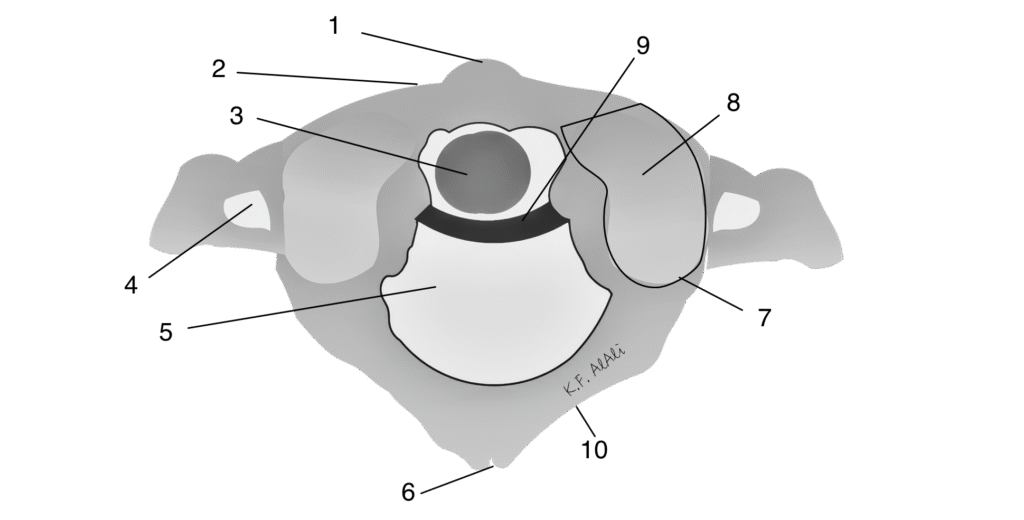
C1 – atlas (superior view): Anterior tuberculum. 2. Anterior arch. 3. Odontoid process of C2. 4. Transverse foramen. 5. Spinal canal. 6. Posterior tuberculum. 7. Lateral mass. 8. Superior articular surface. 9. Transverse ligament. 10. Posterior arch


