
The C2 vertebra (axis) is the second cervical vertebra, distinguished by its odontoid process (dens), which articulates with C1 to enable head rotation. It provides both stability and mobility at the atlantoaxial joint and is a common site for fractures and surgical fixation in cervical spine procedures.
Odontoid Process (Dens)
- Peg-like projection extending superiorly from the C2 body.
- Articulates with the anterior arch of C1.
- Pivot point for atlantoaxial rotation.
- Stabilized by the transverse ligament of the atlas.
Body
- Central, weight-bearing part of the vertebra.
- Continuous with the dens superiorly.
- Supports transmission of axial load to lower cervical vertebrae.
Superior Articular Surface
- Articulates with the inferior articular facets of C1 (atlas).
- Convex or flat to allow axial rotation.
Superior Articular Facet
- Smooth cartilage-covered surface for articulation with the atlas.
- Part of the atlantoaxial joint, enabling rotational mobility.
Pars Articularis
- Segment between the superior and inferior articular processes.
- Important structurally and surgically (for screw placement).
Pedicle
- Connects the vertebral body to the posterior elements (laminae, facets).
- Forms the lateral walls of the vertebral foramen.
- Often used as an anchoring site for C2 pedicle screws.
Inferior Articular Surface
- Articulates with the superior articular facets of C3.
- Allows for extension and flexion movements between C2 and C3.
Inferior Articular Facet
- Smooth, flat surface facing anteroinferiorly.
- Completes the zygapophyseal joint with C3.
Spinous Process
- Prominent, bifid posterior projection.
- Attachment site for posterior cervical musculature.
- Palpable midline landmark in clinical exam.
Lamina
- Posterior arch of bone connecting the spinous process to the transverse process.
- Forms part of the vertebral arch protecting the spinal canal.
Transverse Foramen
- Located within the transverse process.
- Transmits the vertebral artery and vein, along with sympathetic nerves.
Transverse Process
- Lateral bony projection providing muscle and ligament attachment.
- Contains the transverse foramen.
- Less prominent in C2 than in lower cervical vertebrae.
Spinal Canal
- Encloses and protects the upper cervical spinal cord.
- Formed by the body, pedicles, laminae, and posterior elements.
- Larger at C2 to accommodate cord and CSF movement during head rotation.
Clinical Pearls
- Odontoid fractures (especially Type II) are common injuries of the axis.
- C2-C3 instability may follow trauma or degenerative disease affecting the pars or articular processes.
- C2 pedicle/pars screws are frequently used in posterior cervical instrumentation.
- Preservation of vertebral artery (in transverse foramen) is vital in surgical procedures involving C2.
Images
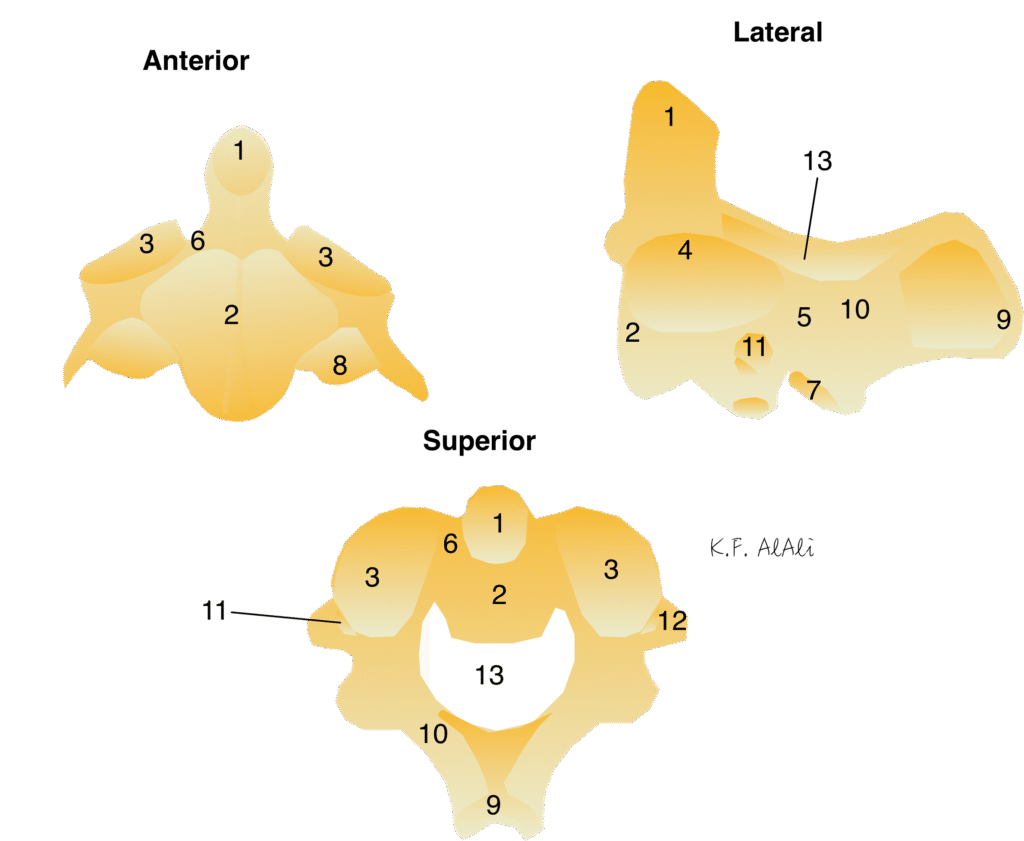
Figure: C2 vertebra: 1. Odontoid process. 2. Body. 3. Superior articular surface. 4. Superior articular facet. 5. Pars articularis. 6. Pedicle. 7. Inferior articualr surface. 8. inferior articular facet. 9. Spinous process. 10. Lamina. 11. Transverse foramen. 12. Transverse process. 13. Spinal canal


